

Nearly every modern speaker offers both wireless and wired connections, and buyers reasonably ask which to use. The Bluetooth vs wired question does not have one answer — it has one answer per job. Understanding the trade-offs between a Bluetooth PA speaker and an XLR or AUX connection prevents the two classic mistakes: performing over Bluetooth, and running cable where nobody needed it.
What Bluetooth is genuinely good at
Bluetooth is the correct choice more often than purists admit. It is ideal for:
- Background music in a restaurant, bar, shop, or office.
- Casual gatherings where guests take turns picking tracks.
- Setup and teardown music before and after an event.
- Any situation where cable is a hazard — across walkways, in a busy dining room, around children.
The advantages are real: no cable to run, no cable to trip over, and a source that fits in a pocket. For atmosphere duty, Bluetooth is simply the sensible option.
Where Bluetooth falls short
- Latency. There is a delay between source and output. Inaudible for background playlists; disqualifying for live performance, instruments, or anything needing lip-sync.
- Compression. Audio is compressed for transmission. Most listeners will not notice on a playlist; it matters more on a critical system.
- Reliability. Dropouts happen — notifications, calls, range limits, a phone that walks away with its owner. Acceptable at brunch, unacceptable during vows or a first dance.
- Single source. One connection at a time, with a pairing dance whenever you switch.

Wired connections, ranked by job
XLR (balanced) — the professional standard. Balanced wiring rejects interference over long runs, and the connector locks so it cannot be pulled out accidentally. Use it for mixers, DJ controllers, and any permanent or semi-permanent installation.
6.35 mm / TRS — common on instruments and many mixers, and frequently offered as a combo jack alongside XLR. Balanced TRS behaves much like XLR; unbalanced connections are better kept short.
AUX / 3.5 mm — convenient and universal, but unbalanced and prone to noise over distance. Fine for a laptop a metre away; not a choice for a stage run.
USB and microSD — playback directly from storage. Underrated in hospitality: a playlist on a card keeps playing when the internet drops and does not leave with a staff member's phone.
A simple decision guide
- Background music, no speeches — Bluetooth.
- Fixed all-day playlist that must not fail — USB or microSD.
- Laptop nearby for a presentation — AUX, kept short.
- DJ set or live performance — XLR or balanced 6.35 mm. Not Bluetooth.
- Microphone for speech — a dedicated mic path, wired or a proper wireless mic system. Never route a mic through Bluetooth.
- Multiple sources at once — wired inputs, because Bluetooth handles one.

Inputs are not included accessories
This distinction causes more purchasing confusion than any other, so it is worth stating plainly. When a specification lists microphone inputs, it is describing sockets you can plug a microphone into. It is not saying a microphone is in the box.
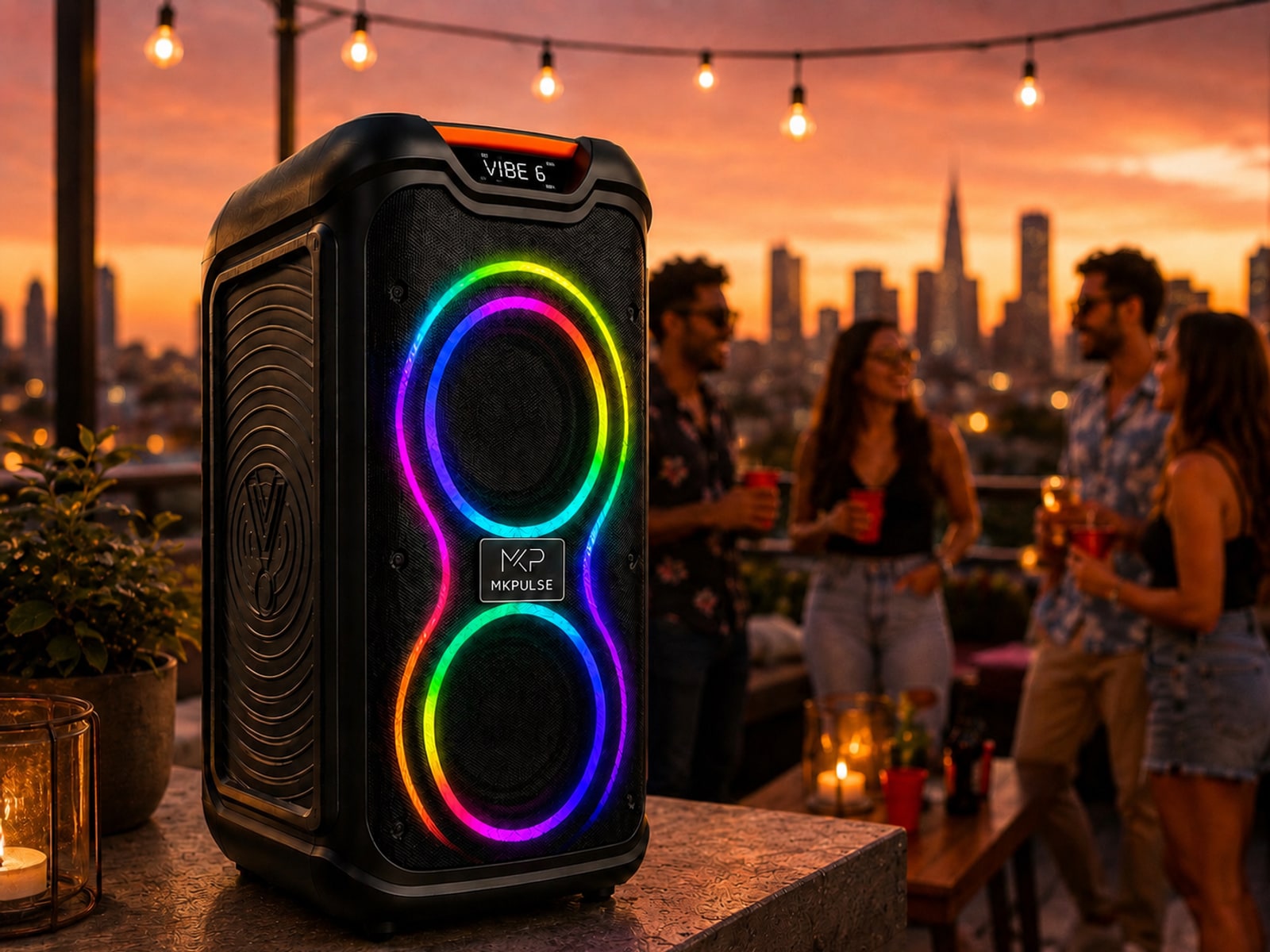
Across the MKPULSE range, the position is straightforward. The VIBE 6 provides wired microphone inputs — a genuinely useful feature for a quiz night or a birthday announcement — and you supply the microphone. The S15 provides dual XLR / 6.35 mm combo inputs for mixers, instruments, and microphones you connect. The P10 is the model that ships with a UHF wireless microphone system and carry bag in the carton.
Before buying any speaker anywhere, read the box contents separately from the feature list. The two lists answer different questions, and conflating them is how buyers end up disappointed on event day.
Using both, as intended
The practical setup for most venues uses both. Bluetooth or USB handles atmosphere during the day. When the room needs speech or performance, you switch to a wired input with a dedicated microphone path. Multi-input speakers exist precisely so you are not forced to choose once and live with it.
Choose the right MKPULSE speaker
- MKPULSE P10 — 10-inch battery PA for hosted, mobile events.
- MKPULSE S15 — 15-inch powered PA for dance floors and larger rooms.
- MKPULSE VIBE 6 — dual 6.5-inch Bluetooth party speaker with dynamic RGB.
- Compare all three models side by side before you decide.